

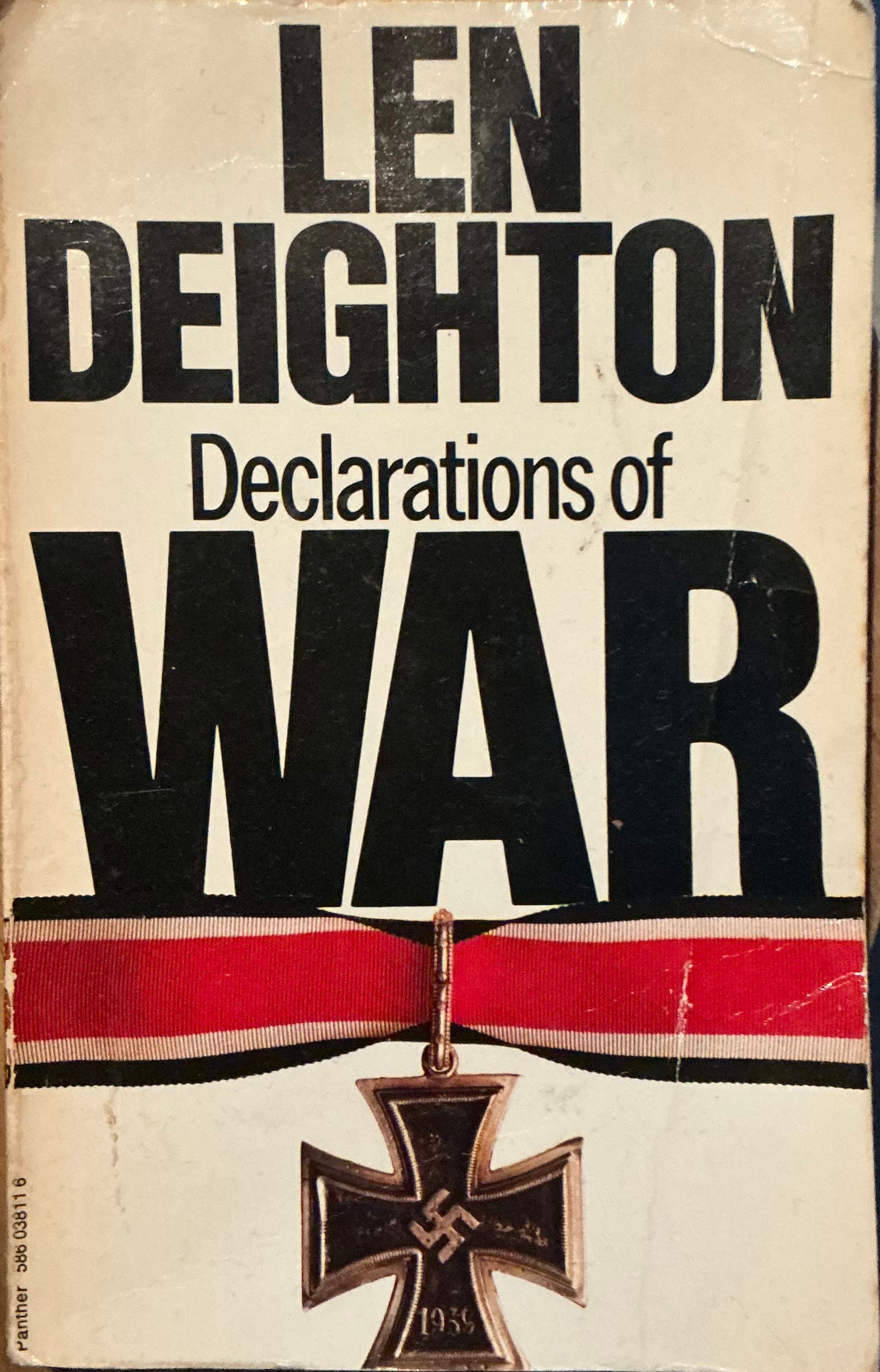
Len Deighton has passed, long live Len Deighton.
In 1975, an English Literature teacher placed Len Deighton’s Declarations of War in my hands as a way of getting me to read Shakespeare’s Romeo and Juliet. It was a calculated exchange, and an effective one. Deighton provided the entry point, pace, clarity, and immediacy, while Shakespeare, once I had worked past the barrier of old English, proved something else entirely. I did not abandon one for the other; I fell for both.
Declarations of War is a series of short stories. The book worked. Not because of any spy thrillers (those came later although they never quite caught me), but because of the wartime stories inside. They felt raw, unsentimental, and true in a way that stayed with me.
One is particularly memorable: “Brent’s Deus Ex Machina,” pages 67 to 76. It opens with a quiet falsehood:
RAF Brimington, a bomber airfield in East Anglia, didn’t exist.
From there Deighton drops us into the world of Flight Lieutenant Dr John Garrard, the base medical officer since 1942. He has watched Bomber Command transform from a scrappy outfit of twin-engined bombers crewed by youngsters into an immense, impersonal force of four-engined heavies. To Garrard the crews have become “less glamorous, less individualistic, more often drawn from the lower income groups… disappointingly inarticulate.”
Then comes Pilot Officer Michael Peter Barnaby Brent: twenty-three, married, two small children (one ten months, one four), 115 total flying hours, twenty-one operational. Three raids over Germany. The prose is flat, clerical—exactly like the forms that would soon decide his fate.
The story unfolds not in the sky but across a desk. Brent wants to be excused from operations. Garrard, polished and literary, wants to avoid branding him LMF—Lack of Moral Fibre, the RAF’s cold label for what others called cowardice. The label is mentioned but not discussed. We now know the deeper tragedy behind the label, but back then I recall fruitlessly asking people what it meant.
Their talk is a series of dead ends: Garrard’s elegant allusions meet Brent’s salesman’s logic. When Garrard mentions a deus ex machina, “an improbable device for bad writers and unlikely plots”, Brent thinks only that this is posh talk for twisting the knife.
On page 72 the acronym finally lands. Brent understands, suddenly and completely, that “society wished to kill him. He had been designed like a bomb, long since costed and programmed on a graph of expandability.” His Midlands-accented wife will never belong among the officers’ wives. His children will grow up fatherless. The machine rolls on.
They settle on a week’s rest. Nothing is resolved.
But Brent takes the final move. He names his Lancaster Deus Ex Machina. When anyone asks, he says with a grin: “It’s an improbable device for ending things.” The mess laughs; the line catches. Overnight the former vacuum-cleaner salesman becomes “a wag”—witty, a character. He tucks his napkin into his collar like a labourer, tells loud dirty jokes, and flies with new gongs earned not from heroics alone but from turning Garrard’s sneer into nose-art defiance.
Deighton never moralises. In ten pages he captured the class war woven into the larger war: the terror of being expendable, the small rebellions men mounted against it. Brent’s painted legend is no cheap resolution; it is a middle finger to a system that had already priced him out.
Looking back, those ten pages from Declarations of War quietly stayed with me, serving as an early engagement with Deighton’s unflinching gaze on the bomber war. But it was his novel Bomber, a monumental, minute-by-minute portrait of a single raid and its human toll on all sides, that proved most influential when I came to write War Comes to Aachen half a century later.
The richness of his prose and research shaped the questions I asked about aerial bombardment’s machinery, its contradictions, and its costs; although my own archival work eventually led me in a different general direction. He likely never knew the lasting echo he left in one reader who would later live in the city his fictional bombers helped illuminate. It’s a gentle reminder of how a writer’s work can quietly endure, nudging another book into existence decades on. My thanks to Len Deighton for the enduring insight and the quiet inspiration.
Very good Philip. That’s one book I’ve not read.
Good stuff, Phil.